


Traditional Japanese Wedding in Kyoto: Kimono, Shinto Ceremony & Etiquette

Updated: 2 days ago
Kyoto is often introduced through its temples, shrines, gardens and historic streets.
But one of the most meaningful ways to understand the city is not simply to look at its traditions—it is to learn how those traditions continue to be practiced today.
Japanese wedding culture offers one such window.
From the pure white shiromuku worn by a bride to the quiet rituals of a Shinto wedding ceremony, traditional Japanese weddings bring together clothing, craftsmanship, religion, etiquette and ideas about family and marriage.

For international couples visiting Kyoto, experiencing these traditions can offer something more meaningful than simply creating beautiful photographs. It can become an opportunity to understand a living part of Japanese culture.
Traditional Japanese Wedding in Kyoto: Quick Answer
A traditional Japanese wedding brings together formal kimono, Shinto ritual, shrine etiquette and family symbolism. In Kyoto, international couples may choose a real Shinto ceremony, a wedding-kimono photoshoot, or both; shrine permission, respectful conduct and route planning must be confirmed for each location.
Why Kyoto and Japanese Wedding Culture Are Deeply Connected

Kyoto served as Japan's imperial capital for more than a thousand years and developed into one of the country's most important centers of religion, craftsmanship, textiles, ceremony and the arts.
Many of these traditions remain visible today.
Shrines continue to hold ceremonies. Kimono artisans continue their craft. Traditional neighborhoods remain places where people live and work. Seasonal customs continue to shape the rhythm of the city.
This is what makes experiencing Japanese wedding culture in Kyoto particularly meaningful.
The surroundings are beautiful, but the experience is not simply about scenery. Wedding kimono, Shinto rituals, traditional craftsmanship and Kyoto's cultural environment are connected parts of a much larger story.
Understanding Traditional Japanese Wedding Attire

One of the most recognizable elements of a traditional Japanese wedding is the clothing.
Shiromuku
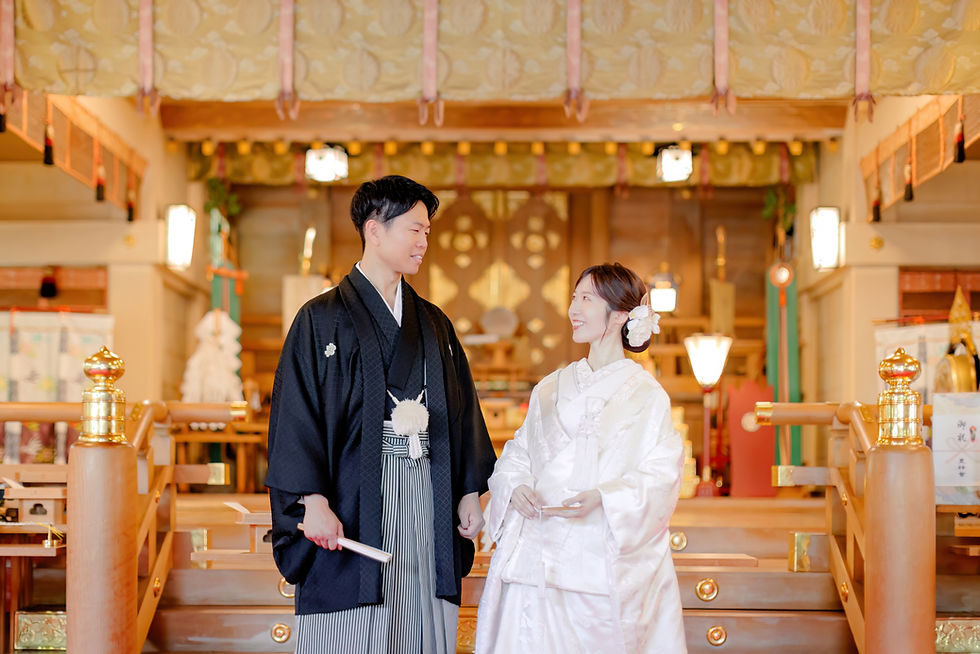
The shiromuku (白無垢) is an all-white formal bridal kimono traditionally associated with Japanese wedding ceremonies.
Its appearance is strikingly simple from a distance, but the garment itself consists of carefully arranged layers, accessories and subtle textile details.
White has long held ceremonial significance in Japan, and the shiromuku has become one of the most iconic expressions of traditional Japanese bridal attire.
Iro-Uchikake
The iro-uchikake (色打掛) offers a dramatic contrast.
These richly decorated outer kimono may feature embroidery, gold thread and traditional motifs such as cranes, flowers, fans, waves or other auspicious designs.
Many of these motifs express wishes connected with longevity, prosperity, happiness or good fortune.
A wedding kimono can therefore be appreciated not simply as beautiful clothing, but as a form of visual storytelling.
Montsuki Hakama
The groom traditionally wears montsuki hakama (紋付袴).
A formal ensemble commonly combines a crested kimono and haori jacket with hakama trousers.
Compared with the elaborate colors and patterns of many bridal garments, the groom's formal attire often creates an elegant and restrained visual balance.
Wedding Kimono Is More Than a Costume

For visitors encountering Japanese wedding clothing for the first time, it can be tempting to see kimono primarily as something beautiful to wear for photographs.
But formal wedding kimono carries cultural meaning beyond appearance.
The textiles, motifs, layers, accessories and methods of dressing all reflect traditions developed over generations.
Professional kitsuke (着付け)—the art of dressing someone in kimono—is therefore an important part of the experience.
Wedding kimono can be heavy and highly structured. Each layer must be arranged carefully to create the appropriate silhouette.
Taking the time to understand this process changes the experience. Instead of simply “putting on a Japanese costume,” visitors begin to appreciate the skill and cultural knowledge involved in wearing formal Japanese attire.
For a deeper introduction to the clothing, symbolism and dressing traditions, read Japanese Wedding Kimono in Kyoto: A Cultural Guide to Shiromuku & Iro-Uchikake.
Shinto Weddings: A Living Religious Tradition

Traditional Japanese wedding culture is also closely associated with Shinto wedding ceremonies, known as shinzen-shiki (神前式).
These ceremonies are conducted at Shinto shrines and may include purification, prayers, ceremonial sake, vows and sacred offerings.
One of the best-known rituals is san-san-kudo (三三九度), in which the couple ceremonially shares sake according to a prescribed sequence.
Other elements may include ritual purification, the presentation of vows and the offering of tamagushi before the kami.
The exact structure differs between shrines.
What is important for visitors to understand is that these rituals are not performances created for tourism. They belong to a religious tradition that continues to be practiced in Japan.
A Shrine Is Not Simply a Beautiful Background
Kyoto's shrines are extraordinarily beautiful. That beauty naturally attracts couples and photographers from around the world.
But a shrine is first and foremost a place of worship.
A couple participating in a Shinto wedding is not simply entering an attractive historic building for photographs. They are entering a sacred space and participating in a religious ceremony.
This distinction matters.
Photography policies, permitted areas, ceremony procedures and rules for outside vendors vary from shrine to shrine.
Visitors should always follow the instructions of priests and shrine staff and avoid treating sacred spaces as photography sets.
For a detailed introduction to Shinto wedding rituals and practical considerations for international couples, read Shinto Wedding in Kyoto: A Cultural Guide for International Couples.
Traditional Japanese Wedding or Pre-Wedding Photography?
These two experiences are sometimes confused. They are related, but they are not the same.
A Traditional Shinto Wedding
A Shinto wedding involves participating in an actual religious marriage ceremony at a shrine.
The focus is the ceremony itself. Photography documents the experience but should never interfere with the ritual.
Wedding Kimono Photography
Wedding kimono photography allows couples to experience traditional bridal attire and create professional portraits without necessarily participating in a religious ceremony.
This may take place in a studio, traditional interior, garden or approved Kyoto location.
Combining Both
Some couples choose to experience both.
They may hold a Shinto ceremony wearing shiromuku and montsuki hakama, followed by additional portraits elsewhere in Kyoto.
Others prefer to focus entirely on the cultural and photographic experience of wearing traditional wedding attire.
Neither option is inherently more authentic. What matters is understanding the difference and choosing an experience that reflects the couple's intentions.
Experiencing Kyoto Beyond the Most Famous Streets
 |  |  |
Heart Art Kyoto wedding locations: Gion streets, bamboo scenery and seasonal cherry blossoms.
A meaningful wedding experience in Kyoto does not need to take place at the city's busiest landmarks.
Kyoto has many different environments. Historic streets are only one part of the city.
There are quiet shrines, gardens, traditional interiors, western districts surrounded by nature and neighborhoods where everyday Kyoto life continues beyond the most heavily visited tourist routes.
Season and time of day also matter. An early morning can feel completely different from midday. Fresh summer greenery creates a different atmosphere from autumn foliage. Winter can reveal a quieter and more restrained side of Kyoto.
Choosing locations thoughtfully can improve the couple's experience while reducing pressure on areas already affected by heavy tourism.
The goal should not always be: “Where is the most famous place to take a photograph?”
A better question can be: “Where can we experience the atmosphere of Kyoto respectfully and meaningfully?”
For couples exploring different possibilities, see Best Kyoto & Nara Pre-Wedding Photoshoot Locations.
Respecting Kyoto While Creating Wedding Memories
Kyoto is an international destination, but it is also home to people who live and work among many of the places visitors hope to experience.
Responsible behavior is therefore particularly important during wedding photography.
Respect Private Property
Traditional neighborhoods contain private homes, shops and entrances. Never enter private property simply because it appears attractive in a photograph.
Keep Streets Accessible
Wedding clothing, photography equipment and groups of people can easily obstruct narrow streets. Keep the group compact and allow residents, workers and other visitors to pass.
Follow Photography Rules
Temples, shrines, gardens and other properties establish their own policies. Professional photography may require advance permission, additional fees or specific procedures. Some places do not permit it at all.
Respect Religious Spaces
When visiting a shrine or temple, remember that other people may be there to worship. Photography should never interfere with religious activity.
Consider Time and Location
Early mornings and less-congested areas can provide a calmer experience while reducing pressure on Kyoto's most crowded locations.
Respecting the city is not separate from experiencing its culture. It is part of the experience.
The Role of Season in a Kyoto Wedding

Kyoto's relationship with the seasons is one of the qualities that gives the city its distinctive character. Wedding experiences change with them.
Spring
Cherry blossoms are internationally famous, but spring also brings fresh greenery and many other seasonal flowers.
Popular blossom areas can become extremely crowded, making careful timing and location selection important.
Summer
Summer brings deep green landscapes and a very different visual atmosphere. Early mornings can be particularly valuable during warmer months.
Autumn
Red and golden leaves create one of Kyoto's most dramatic seasons.
It is also one of the busiest periods of the year, so couples should consider less-crowded locations and realistic travel times.
Winter
Winter is sometimes overlooked. Yet quieter streets, softer light and the contrast between white bridal kimono and subdued winter scenery can create an elegant atmosphere.
There is no single “best” season. The best choice depends on what the couple hopes to experience.
From Observation to Participation
Many visitors experience Kyoto by observing. They walk through historic districts. They visit shrines. They see kimono. They photograph traditional architecture.
There is great value in all of these experiences.
But cultural understanding can become deeper when observation is combined with learning and respectful participation.
Learning why a bride wears shiromuku is different from simply seeing one. Understanding san-san-kudo changes the way a Shinto wedding ceremony is perceived. Learning about kimono dressing reveals the skill hidden beneath the finished appearance. Understanding shrine etiquette changes how visitors move through sacred spaces.
These small pieces of knowledge transform culture from something picturesque into something meaningful.
Can International Couples Experience Japanese Wedding Culture?
Yes.
International visitors can experience many elements of Japanese wedding culture in Kyoto, although the possibilities depend on the type of experience.
Wedding kimono photography is generally more flexible. Actual Shinto ceremonies require advance coordination with a shrine, and policies differ considerably.
International couples should consider:
Whether they want a cultural experience, photography, an actual ceremony or a combination
Which type of wedding kimono they would like to wear
Professional dressing and preparation time
Language support
Location and shrine policies
Photography permissions
Transportation while wearing formal kimono
Seasonal conditions
Cultural and religious etiquette
Planning these elements together creates a much more comfortable experience than treating clothing, ceremony and photography as separate decisions.
Preserving Culture Through Photography

Photography has a natural place within a wedding experience. It preserves a moment that cannot be repeated.
But when working with traditional culture, photography should document the experience rather than dominate it.
The best photograph does not always come from controlling every element of the environment. Sometimes it comes from allowing the ceremony, clothing, season and atmosphere of Kyoto to remain themselves.
For international couples, these photographs can later serve as more than wedding portraits. They can become reminders of what the couple learned, experienced and shared during their time in Japan.
Heart Art's Approach to Japanese Wedding Culture
Heart Art is based in Kyoto and welcomes couples from around the world.
Our approach begins with a simple idea: Japanese wedding culture should be experienced with understanding and respect—not treated only as a visual theme.
Depending on the couple's wishes, an experience may bring together traditional wedding kimono, professional kitsuke, bridal hair and makeup, cultural guidance, Shinto wedding coordination and photography.
Support is available in English, Traditional Chinese, Simplified Chinese and Japanese.
When working in Kyoto, we also place importance on respecting shrine policies, photography permissions, local communities and the cultural meaning of the places in which we work.
Our hope is that visitors return home not only with beautiful photographs, but also with a deeper understanding of the traditions they experienced.
Frequently Asked Questions
What is a traditional Japanese wedding?
There is no single format that represents every Japanese wedding. One important traditional form is the Shinto wedding ceremony held at a shrine, often accompanied by formal Japanese wedding attire.
What is the difference between shiromuku and iro-uchikake?
Shiromuku is an all-white formal bridal kimono. Iro-uchikake is a richly decorated outer wedding kimono featuring colors, embroidery and auspicious motifs.
Can foreigners wear Japanese wedding kimono in Kyoto?
Yes. International visitors can experience traditional wedding attire. Professional dressing and cultural guidance can help visitors understand the meaning behind what they are wearing.
Can foreigners have a Shinto wedding in Kyoto?
Some shrines accept international couples, but eligibility, language support, reservation procedures and ceremony policies vary. Couples should confirm requirements in advance.
Do we need a Shinto ceremony to wear wedding kimono?
No. Couples can experience and photograph traditional wedding kimono without participating in a religious ceremony.
Can we take professional wedding photos anywhere in Kyoto?
No. Photography policies differ between public spaces, shrines, temples, gardens and private properties. Some locations require advance permission or fees, while others prohibit professional photography.
When is the best time for wedding photography in Kyoto?
There is no single best season. Spring, summer, autumn and winter each offer different scenery and atmosphere. Crowd levels, temperature and photography regulations should be considered alongside appearance.
Is a Shinto wedding legally binding?
A religious Shinto ceremony and civil marriage registration are separate matters. Couples who require legal registration should check the relevant procedures with the appropriate authorities.
Discovering Kyoto Through a Living Tradition
Kyoto's cultural heritage is extraordinary partly because so much of it remains alive.
Kimono is still worn. Artisans continue traditional crafts. Shrines remain places of worship. Ceremonies continue to be practiced.
Wedding culture brings many of these elements together.
For international couples, taking the time to understand them can transform a wedding experience in Kyoto from something simply beautiful into something deeply memorable.
The goal is not to recreate an image of the past.
It is to encounter a tradition that continues to live in Kyoto today—and to become part of that moment with curiosity, gratitude and respect.
 |  |
Heart Art wedding photography connecting traditional attire with shrine scenery and Kyoto atmosphere.


Comments